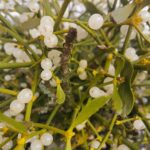

Understanding the water requirements of white mistletoe is fundamentally about understanding its relationship with its host tree. As a hemiparasitic plant, mistletoe does not have its own root system in the soil to absorb water. Instead, it develops a specialized structure called a haustorium that penetrates the host tree’s branches and connects directly to its vascular system, specifically the xylem. This connection allows the mistletoe to draw a significant portion of the water and dissolved mineral nutrients that the host tree has worked to pull up from the ground. Therefore, you never water the mistletoe directly; you ensure the host has enough water for both of them.
The mistletoe’s demand for water is surprisingly high, often exceeding that of its host on a leaf-by-leaf basis. Mistletoe leaves have a high density of stomata, which are pores that regulate gas exchange and water transpiration, and these stomata often remain open even when the host tree’s stomata close to conserve water during dry periods. This physiological trait ensures a continuous flow of water from the host to the parasite, effectively giving the mistletoe a competitive advantage for this essential resource. This is why the host tree’s access to adequate soil moisture is the single most important factor in the water relations of the entire system.
Consequently, any irrigation plan for mistletoe is, in reality, an irrigation plan for the host tree. The goal is to prevent the host from experiencing severe drought stress, which could be exacerbated by the constant water demands of the mistletoe. A stressed host tree may struggle to support itself and the parasite, potentially leading to branch dieback, a decline in overall health, and a reduction in the tree’s ability to defend itself against other pests and diseases. A well-hydrated host is the foundation for a healthy mistletoe specimen.
It is a common misconception that because mistletoe is a parasite, it thrives when the host is weak. In reality, the opposite is true for this hemiparasite. White mistletoe flourishes when its host is healthy and has access to ample resources, including water. A vigorous, well-watered host tree can easily support a moderate population of mistletoe for many decades with little ill effect. The problems arise when resources, particularly water, become scarce, and the competition between the two organisms intensifies to the detriment of the host.
Assessing the host tree’s water needs
The first step in managing the water supply for mistletoe is to accurately assess the water needs of the host tree. This will vary greatly depending on the tree’s species, age, size, and the prevailing environmental conditions. A large, mature deciduous tree like a poplar or an apple tree will have significantly higher water requirements during the hot, dry summer months than a smaller, more drought-tolerant species. Understanding the specific needs of the host is critical to providing the right amount of supplemental water.
More articles on this topic
A simple and effective way to check for water stress is to examine the soil around the base of the host tree. Dig a small hole with a trowel to a depth of about 15-20 centimeters, well within the tree’s primary root zone. If the soil at this depth is dry and crumbly, it is a clear indication that the tree is not receiving enough moisture and supplemental irrigation is needed. The soil should ideally feel cool and slightly damp to the touch, but not waterlogged. This manual check provides a much more accurate picture than a superficial glance at the soil surface.
Visual cues from the host tree itself can also signal water stress. Early warning signs include a slight wilting or drooping of the leaves during the hottest part of the day, a loss of luster or a dulling of the leaf color, or premature yellowing and dropping of leaves from the inner parts of the canopy. If you see these signs, the tree is already experiencing a significant moisture deficit. At this point, the competition for water with the mistletoe is becoming critical, and providing a deep, thorough watering is essential to help the host recover.
It’s also important to consider the recent weather patterns. A long period without significant rainfall, especially when combined with high temperatures and wind, will rapidly deplete the soil moisture reserves available to the host tree. Proactive irrigation is always better than reactive irrigation. If you know a dry spell is forecast, it is wise to provide a deep watering to the host tree beforehand, effectively “charging” the soil with moisture. This preventative approach helps the host tree endure the dry period without falling into a state of stress.
Proper irrigation techniques for the host
When it is time to irrigate, the technique used is crucial for effectiveness. A light, superficial sprinkling of the ground is of little use to a mature tree. The majority of a tree’s feeder roots, which are responsible for water absorption, are located in the top 30-50 centimeters of the soil and extend out to the edge of its canopy, known as the dripline, and often beyond. The goal is to deliver water slowly and deeply throughout this entire root zone, encouraging deep root growth and ensuring the water reaches where it is most needed.
More articles on this topic
One of the best methods for deep watering a mature tree is to use a soaker hose or a drip irrigation system. Lay the hose in a spiral or a zigzag pattern under the tree’s canopy, starting about a meter from the trunk and extending out to the dripline. Let the water run at a low volume for several hours. This slow application allows the water to penetrate deep into the soil profile without causing runoff or evaporation. This method is far more efficient and beneficial than a short, powerful blast from a standard hose.
The frequency of irrigation is just as important as the technique. It is much better to provide a deep, infrequent watering than shallow, frequent waterings. A deep watering every one to two weeks during a period of drought is typically more effective than a light watering every few days. Shallow watering encourages the development of a shallow root system, making the tree even more vulnerable to drought. Deep watering, on the other hand, promotes a more extensive and resilient root system that can better access moisture from a larger volume of soil.
Avoid watering directly at the base of the tree trunk. Consistently wet bark can create an environment conducive to fungal diseases and decay. The most active water-absorbing roots are not located at the trunk but are spread throughout the area under the canopy. Concentrating water away from the trunk and towards the dripline ensures that it is delivered to the most efficient part of the root system and keeps the base of the tree healthier.
Mistletoe’s role in water relations
The presence of mistletoe fundamentally alters the water dynamics of the host branch it inhabits. The haustorium of the mistletoe taps directly into the xylem, the host’s water-conducting tissue. Because the mistletoe’s transpiration rate is often higher than the host’s, it creates a powerful “sink,” continuously pulling water towards itself. This can create localized water stress in the host branch, even when the rest of the tree appears to be adequately hydrated. You might observe the leaves on a heavily infested branch wilting sooner than leaves on other parts of the tree.
This constant siphoning of water has significant implications during periods of drought. As the host tree begins to conserve water by closing its stomata, the mistletoe’s stomata may remain open, continuing to transpire and pull water from the host’s reserves. This can severely dehydrate the branch on which the mistletoe is located, leading to dieback of the branch from its tip back towards the mistletoe. In severe infestations on an already stressed tree, this can contribute to the overall decline and eventual death of the host.
It is also worth noting that the mistletoe itself can show signs of water stress. Although it is a very effective water scavenger, if the host tree becomes so severely dehydrated that its water potential drops significantly, the mistletoe will also begin to suffer. The leaves of the mistletoe may appear limp, lose their turgidity, and may eventually turn a pale, sickly green or yellow. Seeing a wilting mistletoe plant is a very strong indicator that its host tree is under extreme drought stress and is in urgent need of deep watering.
Therefore, managing a tree with mistletoe requires a heightened awareness of water availability. The presence of the parasite reduces the host’s resilience to drought. Trees that might otherwise handle a normal dry summer without issue may show signs of stress when they are also supporting a significant mistletoe population. This necessitates a more proactive and vigilant approach to monitoring soil moisture and providing supplemental irrigation to ensure the long-term health and survival of the host tree.
Special considerations and adaptations
The relationship between mistletoe and its host is not entirely one-sided when it comes to water. While the mistletoe is an effective parasite, the host tree is not entirely defenseless. Some tree species have the ability to form what is known as a “tylosis,” which is a blockage in the xylem vessels. This can effectively seal off the vascular connection to the mistletoe, essentially cutting off its water supply and killing it. However, this is a stress reaction and is not a reliable method of control, nor does it happen in all host species.
The physical structure of the mistletoe clump itself can have a minor effect on the water on the branch. A large, dense clump can intercept some rainfall, creating a “rain shadow” on the branch directly beneath it. This is generally a negligible effect in the grand scheme of the host’s overall water uptake from the soil but is an interesting aspect of the physical interaction. The dense foliage of the evergreen mistletoe can also slightly increase water loss from the tree as a whole during winter, as it continues to transpire while the deciduous host is dormant.
It is crucial to adjust irrigation practices based on the season. The highest water demand for both the host tree and the mistletoe will be during the summer months when transpiration rates are at their peak due to heat and longer daylight hours. In contrast, during the dormant winter season, the water needs of the deciduous host are dramatically reduced. While the evergreen mistletoe continues to use some water, the overall demand on the system is much lower, and supplemental irrigation is typically unnecessary unless there is an unusually prolonged and dry winter.
Finally, in cases of very heavy mistletoe infestation on a valuable host tree, managing the parasite load can be considered a form of water management. By selectively pruning some of the largest mistletoe clumps, you directly reduce the total transpirational surface area and thus lessen the overall water demand placed upon the host. This can be a very effective strategy to improve the host’s water balance and increase its resilience during periods of drought, helping to ensure its long-term survival and health.