
Understanding the unique nature of white mistletoe is the absolute cornerstone of its successful cultivation and management. Unlike terrestrial plants that draw their sustenance from the soil, this fascinating organism is a hemiparasite, meaning it derives water and mineral nutrients from a host tree while performing its own photosynthesis. Therefore, caring for mistletoe is intrinsically linked to caring for its host. The health, age, and species of the host tree directly dictate the viability and vigor of the mistletoe clump. A robust and healthy host can support a moderate mistletoe population without significant detriment, turning the relationship into a long-term cohabitation.
The primary consideration in mistletoe care is not about feeding or watering the mistletoe itself, but about ensuring the host tree remains in optimal condition. This involves proper irrigation for the tree during periods of drought, protecting it from soil compaction around its root zone, and avoiding any mechanical damage to the trunk or limbs. When the host tree is stressed due to environmental factors, disease, or pests, the mistletoe can become an additional burden, potentially accelerating the decline of the tree. Therefore, any care regimen must prioritize the host’s well-being as the foundation for a healthy mistletoe specimen.
Furthermore, the interaction between mistletoe and its host is a delicate balance. The mistletoe’s specialized root system, called a haustorium, penetrates the host’s bark and vascular tissues to tap into its water and nutrient supply. While a mature, healthy tree can tolerate this, a young or weakened tree may suffer from the competition for resources. Regular observation of the host tree for signs of stress, such as yellowing leaves, dieback of branches, or reduced growth, is a critical aspect of responsible mistletoe management. It is a continuous process of monitoring and maintaining equilibrium.
Ultimately, caring for white mistletoe is an exercise in ecological management rather than traditional horticulture. It requires a shift in perspective from nurturing an individual plant to overseeing a complex biological interaction. The goal is to foster a sustainable relationship where both the parasite and the host can thrive. This involves understanding the lifecycle of both organisms and making informed decisions that support the overall health of the micro-ecosystem they create together on a single tree.
Selecting the appropriate host
The choice of host tree is perhaps the single most critical factor in the long-term health and success of white mistletoe. Not all tree species are suitable hosts; Viscum album shows a strong preference for certain types, most commonly poplars, willows, apple trees, and hawthorns. Attempting to cultivate it on an incompatible species will invariably lead to failure, as the mistletoe’s haustorium will be unable to successfully establish a connection with the host’s vascular system. Researching the specific subspecies of mistletoe and its preferred hosts in your region is a fundamental first step.
More articles on this topic
Beyond the species, the individual health and age of the potential host tree are paramount. A young, rapidly growing tree may be too vigorous, potentially compartmentalizing and rejecting the penetrating haustorium before it can establish. Conversely, an old or already declining tree may not have the resources to support both itself and the additional burden of a hemiparasite, leading to the premature death of both. The ideal candidate is a mature, healthy, and well-established tree with a strong framework and no pre-existing signs of significant stress or disease.
The location of the mistletoe on the host tree also plays a significant role in its development and the overall impact on the host. Mistletoe is most successfully established on younger branches, typically between two to ten years old, where the bark is not yet too thick for the germinating seed’s radicle to penetrate. Planting on the main trunk or very old, thick-barked limbs is rarely successful. Furthermore, it should be situated in a position that receives adequate sunlight, as mistletoe, being a photosynthesizing organism, requires light for energy production.
Finally, one must consider the long-term implications of introducing mistletoe to a host. A single mistletoe plant can grow into a large, dense clump over many years, potentially becoming heavy enough to cause branch breakage during high winds or heavy snow. The water demand of a large infestation can also become a significant drain on the host during dry periods. Therefore, selecting a host with a strong branch structure and considering the potential future need for management and pruning is a crucial part of responsible and sustainable care.
Monitoring for health and balance
Vigilant and regular monitoring is essential to maintaining the delicate balance between the white mistletoe and its host tree. This is not a plant you can simply establish and forget; it requires an ongoing assessment of both organisms. Observe the mistletoe’s own foliage for signs of health: the leaves should be a vibrant green, turgid, and free from significant blemishes or discoloration. Wilting, yellowing, or premature leaf drop on the mistletoe itself can indicate a problem not with the parasite, but with the host’s ability to supply sufficient water and nutrients.
More articles on this topic
Simultaneously, pay close attention to the host branch on which the mistletoe is growing. Look for any signs of cankers, swelling, or dieback on the branch beyond the point of the mistletoe’s attachment. While some swelling at the immediate point of connection is normal, a progressive decline of the entire host limb is a red flag. This indicates that the mistletoe’s demands are exceeding the branch’s capacity to support it, and intervention may be necessary to preserve the health of the larger tree. This is especially important in the case of multiple mistletoe clumps on a single branch.
The overall health of the host tree provides the most critical clues. A healthy host supporting a balanced mistletoe population will continue its normal cycle of leafing out, flowering, and fruiting without a noticeable decrease in vigor. Warning signs include a general thinning of the tree’s canopy, smaller-than-usual leaves, a reduction in annual growth, or stress-induced flowering or fruiting. These symptoms suggest that the cumulative burden of the mistletoe, possibly combined with other environmental stressors, is becoming too great for the host to bear.
During these monitoring sessions, it is also wise to check for the presence of any secondary pests or diseases that might be attracted to either the mistletoe or the potentially stressed host. For instance, certain insects are specifically attracted to mistletoe, and while some may be harmless, others could pose a threat. Likewise, a weakened host branch can be more susceptible to fungal infections. Early detection and identification of such issues are key to preventing minor problems from escalating into major threats to the entire system.
Managing growth and density
While a single clump of mistletoe can be a beautiful and interesting feature, unmanaged proliferation can become detrimental to the host tree. The seeds of white mistletoe are primarily spread by birds, which eat the sticky white berries and then wipe the seeds from their beaks onto the branches of other trees, or excrete them. If a host tree becomes heavily infested with numerous mistletoe clumps, the cumulative drain on its water and nutrients can be severe, leading to stunted growth, branch dieback, and increased susceptibility to other stressors like drought and disease.
Therefore, an essential aspect of long-term care involves managing the density of the mistletoe population on a given host. This does not necessarily mean removing it entirely, but rather controlling its spread and size. The most effective way to do this is by regularly pruning the mistletoe itself. By cutting back the mistletoe clumps, you reduce their foliage, which in turn reduces their photosynthetic capacity and, more importantly, their demand for water from the host. This can help to restore a more sustainable balance between the two organisms.
The timing of this management is important. Pruning is best done in late winter or early spring, before the host tree begins its most active growth phase. This minimizes stress on the host and allows it to recover and allocate resources more effectively as the growing season begins. When pruning, it is crucial to cut the mistletoe back as close as possible to the host branch. However, it is important to understand that this is only a temporary solution, as the internal haustorial system will remain within the host’s tissues and will eventually resprout.
For a more permanent solution to control density, the entire host branch on which an unwanted mistletoe clump is growing may need to be removed. This is a more drastic measure and should be reserved for situations where a branch is heavily infested or is showing signs of significant decline. When removing a host branch, it is essential to use proper arboricultural pruning techniques, cutting back to the branch collar to allow the tree to heal properly. This strategic removal can prevent the further spread of seeds and reduce the overall load on the host tree.
Responding to environmental stress
Environmental stressors such as prolonged drought, extreme heat, or unusually harsh winters can significantly impact the relationship between white mistletoe and its host. During a drought, for example, the host tree is already struggling to draw sufficient water from the soil for its own needs. The additional and unrelenting water demand from the mistletoe can push the host beyond its limits, leading to severe stress, leaf drop, and even the death of entire branches. In these situations, providing supplemental deep watering to the host tree’s root zone is the most effective intervention.
In regions with heavy snowfall or frequent ice storms, the physical weight of mistletoe clumps can become a serious liability. The dense, evergreen structure of a mistletoe clump catches and holds snow and ice far more effectively than the bare branches of its deciduous host. This added weight can lead to mechanical failure, causing branches to snap and potentially causing significant damage to the host tree’s structure. Proactively thinning the mistletoe clumps before winter can reduce this risk by decreasing their surface area and overall weight.
Changes in light conditions can also affect the mistletoe-host dynamic. For instance, if a neighboring tree that once provided partial shade is removed, the host and its attached mistletoe may suddenly be exposed to more intense sunlight and heat. This can increase water loss through transpiration for both organisms, potentially creating stress if water is limited. While mistletoe requires light for photosynthesis, a sudden and drastic increase in exposure can be challenging, and ensuring the host has adequate moisture becomes even more critical.
Conversely, a reduction in light, perhaps due to the growth of surrounding vegetation, can negatively impact the mistletoe’s ability to photosynthesize. While it draws water and nutrients from the host, it still needs to produce its own sugars for energy. If light becomes too limited, the mistletoe may decline. While this might seem beneficial to the host, a dying and decaying mistletoe clump can create an entry point for fungal diseases or insect pests, so it is often best to prune away the declining mistletoe to maintain the health of the host branch.
Understanding the lifecycle for better care
Effective care for white mistletoe is deeply rooted in understanding its annual lifecycle and how it synchronizes with that of its host. The plant is dioecious, meaning individual plants are either male or female. Inconspicuous flowers appear in late winter or early spring, and pollination is typically carried out by insects. A lack of pollination will, of course, mean that the female plants will not produce their characteristic white berries. Ensuring there are both male and female plants in proximity, if fruit is desired, is a consideration, though often nature takes care of this through bird-aided seed dispersal.
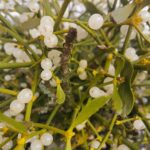
The development of the berries is a slow process that takes place over the summer and autumn months. The berries, containing a single seed encased in a sticky pulp called viscin, mature in late autumn and persist through the winter. This timing is a key survival strategy, as the berries become a valuable food source for birds like thrushes and waxwings when other food is scarce. It is during this period that seed dispersal occurs, so if the goal is to limit the spread of mistletoe to other trees or other parts of the same tree, removing the berries before they are eaten by birds can be an effective control measure.
The germination process is unique and begins in the spring following dispersal. The seed, stuck to a branch by the viscin, does not need soil. It responds to light and gravity, extending a radicle that grows towards the bark. Once it makes contact, it forms a holdfast and begins the slow process of penetrating the host’s tissues. This initial establishment phase is the most vulnerable point in the mistletoe’s life; the seedling is susceptible to drying out and may fail to penetrate the bark.
Once the haustorium has successfully connected with the host’s xylem and phloem, the mistletoe’s growth is slow and steady. It may take several years for a new plant to become easily visible and another few years before it is mature enough to flower and produce its own berries. This slow development means that the full impact of a new mistletoe plant on its host is not immediate. This knowledge allows for a proactive approach to management, where young, undesirable growths can be identified and removed long before they become large and problematic.